
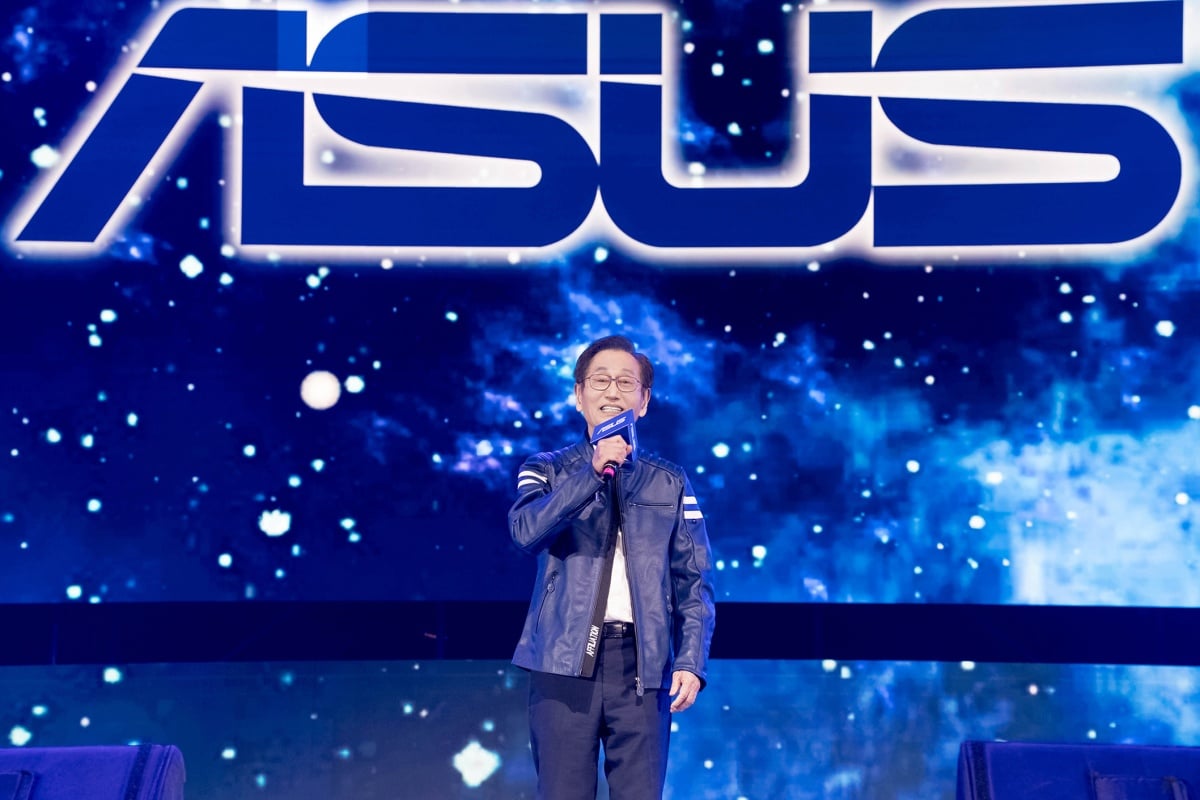
ASUS held its "2025 Year-End Party" at the Taipei Nangang Exhibition Center today (January 16). The party not only rewarded employees with eight cars and many prizes, but also became a key moment for ASUS to announce its future strategy. Chairman Jonney Shih confirmed in a pre-party interview that ASUS will temporarily stop launching new mobile phones and will shift its R&D resources to commercial PCs and "Physical AI" to fully seize the wave of the Fourth Industrial Revolution.
AI-driven, revenue reaches 100 billion ahead of schedule
Shih Chung-tang pointed out that even in the face of geopolitical and tariff challenges, ASUS achieved a total revenue of NT$7389.1 billion for the year, a year-on-year increase of 26.1%, thanks to its proactive deployment in the field of AI. The AI server business even achieved a 100% doubling growth target.
The theme of the gala was "AI Leading the Future," and Shih Chung-tang used this to encourage colleagues to seize this "once-in-a-lifetime" opportunity and thoroughly implement the market strategy of "Ubiquitous AI. Incredible Possibility." He emphasized that the future world will be filled with "artificial brains" with self-learning capabilities, and ASUS must push AI to its limits to evolve product innovation and operational processes.
Are Zenfone and ROG Phone becoming history?
However, the most attention-grabbing aspect of the entire event was clearly Shih Chung-tang's remarks on...ASUS mobile phone businessattitude.
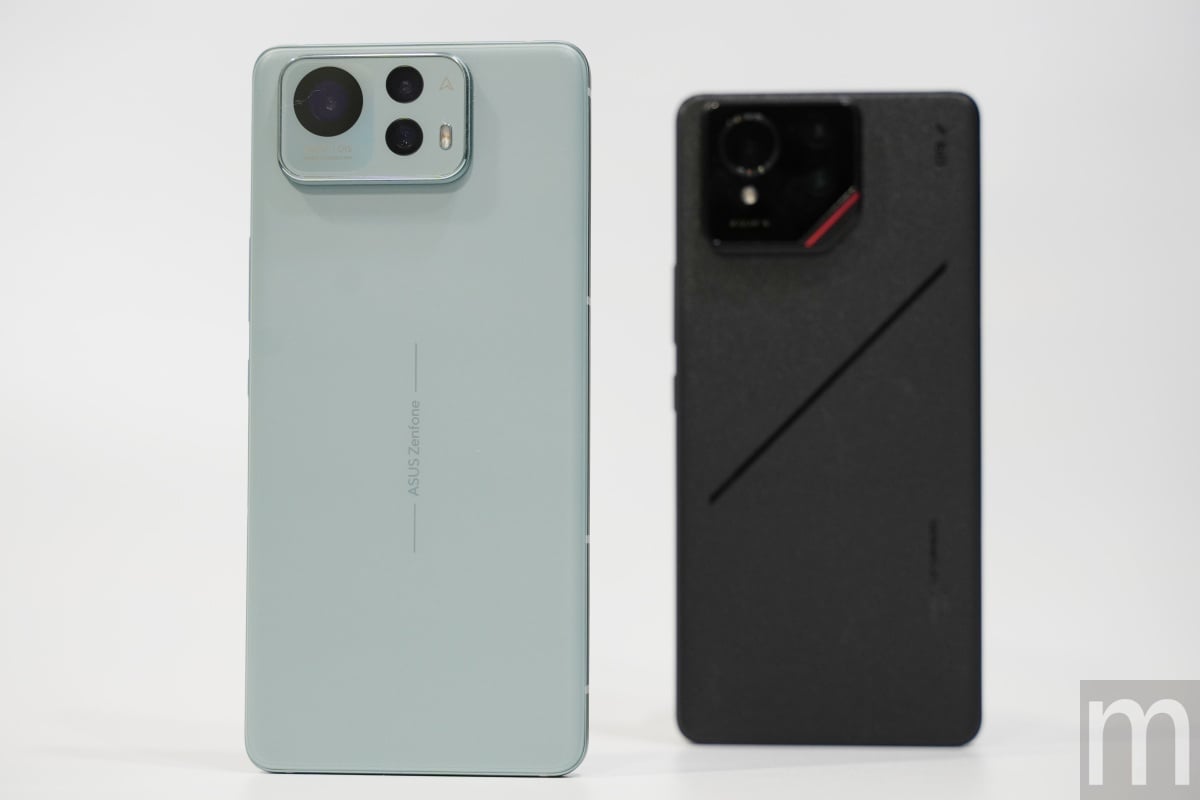
When asked by the media, Shih Chung-tang clearly stated, "ASUS will no longer add new mobile phone models in the future." Although he reservedly indicated that he "will continue to take care of the brand's mobile phone users," he also mentioned that he is still trying to develop relevant measures. Therefore, this response has been interpreted by the outside world as ASUS's mobile phone business entering a state of "substantial withdrawal" or "indefinite observation."
This means that the Zenfone series, which once led the market, and the ROG Phone, a benchmark for gaming phones, may come to an end in 2026.
Resource Shift: From Mobile Phones to Physical AI
As for why we should declutter, Shih Chung-tang's answer is very pragmatic: to prepare for the future "paradigm shift".
ASUS has decided to shift resources originally invested in mobile phone R&D to commercial PCs and physical AI devices, which have greater growth potential. Specifically, ASUS is accelerating its efforts in the two major areas of "AI Robot & Robotics" and "AI Glasses".
Analysis indicates that, given the mobile phone division's extensive experience in Qualcomm platform development, the transfer of this talent and technology to commercial laptops based on the Snapdragon X platform or physical AI devices based on the Dragonwing platform will have a high degree of technological continuity.
Memory price increases may lead to price hikes for non-AI products.
In addition to strategic transformation, Jonney Shih also frankly admitted that the supply chain is currently facing severe challenges. Memory shortages and price increases are putting pressure on non-AI products. He stated frankly, "Price increases are indeed one aspect," but ASUS will strive to provide the best price combination through design thinking and supply chain collaboration.
Regarding the recent agreement on a 15% tariff between Taiwan and the United States, which will not be imposed on each other, Shih Chung-tang believes that this is "of course a good thing," but he emphasizes that the key is still to maintain the resilience and competitiveness of the supply chain.
Analysis of viewpoints
The withdrawal of ASUS mobile phones is regrettable for fans, but from a business perspective, it may be an unavoidable choice.
In a market already saturated with competition, and with the Zenfone series struggling to compete with brands like Apple and Samsung in terms of camera and ecosystem, and the ROG Phone, while penetrating the specific market of hardcore gamers, also struggling to sustain its massive costs, continuing to burn money to maintain a product line that is "praised but not sold" is unwise for a company seeking profits.
ASUS's decision to bet its resources on physical AI fields, including robotics and smart glasses, may be a risky move, but it could also be a wise one. Because with the ever-increasing power of AI models, whoever can create the best "AI vehicle" has the opportunity to define the next decade.
If ASUS can transform the cutting-edge craftsmanship it developed for the ROG Phone into the foundation for creating the "most powerful AI glasses" or the "smartest robot," then the "sacrifice" of Zenfone might just lead to ASUS's rebirth in the AI era.
